
Transparent Product Data for Compliance, the Circular Economy, and Digital Services
The Digital Product Passport provides structured access to relevant product information throughout the entire product lifecycle. As a result, it introduces new requirements for product data, data quality, identification, governance, and system integration.
We support companies in preparing the necessary data, processes, and architectures for the Digital Product Passport (DPP) and implementing them step by step – from the readiness analysis to technical integration.
Significance
From a Regulatory Issue to a Data and Architecture Challenge
The Digital Product Passport is a central component of the EU Regulation on Ecodesign for Sustainable Products (ESPR). The specific information required for a product is defined on a product-group-specific basis through corresponding requirements.
For companies, this means that relevant product information must not only be available; it must also be structured, up-to-date, traceable, and made accessible to different user groups in a controlled manner.
This makes the DPP, above all, a data management and integration task.
Challenge
When product data is scattered across systems and supply chains
The biggest challenge with the Digital Product Passport rarely lies in the QR code itself. The key is to reliably consolidate the necessary information from various systems, business units, and external sources and keep it up to date on an ongoing basis.
Typical challenges include:
- Product data is scattered across ERP, PIM, PLM, and other systems.
- Information from suppliers and partners is missing or available in different formats.
- Data quality, responsibilities, and update processes are not clearly defined.
- Existing systems and interfaces are not prepared for the new data flows.
- Access rights and visibility must be managed for different user groups.
- Product information must be made available digitally in a simple and reliable manner.
- Requirements may change depending on the product group and regulatory developments.
This makes the DPP not just a compliance task, but a company-wide data and integration project.
Requirements
What Requirements the Digital Product Passport Establishes
A DPP links product information to a unique product identifier and a machine-readable data carrier. Access to information is governed by the respective requirements and access rights; not all product data is stored centrally in an EU system.
Among other things, companies must clarify:
- what product data is required,
- from which systems and supply chains it originates,
- how products, components, and relevant entities are uniquely identified,
- which data is publicly accessible or accessible only to specific stakeholders,
- how timeliness, quality, and origin are ensured,
- how regulatory changes will be addressed in the future,
- and how the DPP will be integrated into existing product and business processes.
Data Base
Reliable product data is at the heart of the DPP
The required information is often scattered across ERP, PIM, PLM, MDM, supplier portals, sustainability systems, and other applications.
We help identify these data sources, harmonize them from a business perspective, and establish clear responsibilities.
This includes, for example:
- Product and variant master data,
- material and component information,
- manufacturer and supplier data,
- origin and sustainability information,
- repair, maintenance, and recycling information,
- certificates and compliance data,
- unique product and company identifiers.
The key is not to duplicate all information in a new system, but to create a robust data foundation and clear data flows.
Integration
Connecting existing systems in a smart way
A Digital Product Passport is rarely created within a single system. Product information must be consolidated from various sources, updated, and made available in a controlled manner.
Among other things, we connect:
- ERP
- PIM
- PLM
- MDM
- commerce platforms
- supplier and supply chain systems
- data platforms
- external registries and services
APIs, events, and standardized data models enable automated and scalable data exchange. At the same time, role-based and access control mechanisms ensure that different stakeholders receive only the information intended for them.
Our Approach
From DPP Readiness to Production Implementation
1. Develop a Data Strategy
We analyze what product information is needed, where it is currently stored, and who is responsible for ensuring its quality and timeliness. Together, we create a structured foundation for data collection, data models, and governance.
2. Establish the Technological Foundation
We define how ERP, PIM, PLM, MDM, and other relevant systems should interact and develop the appropriate integration and target architecture.
3. Integrate Partners and Supply Chains
We identify early on what information is needed from suppliers and business partners, how this information is exchanged, and what quality and accountability models are required.
4. Implementing Deployment and Scaling
We ensure that the relevant information is easily accessible to the respective user groups while maintaining appropriate access controls – for example, via a machine-readable data carrier such as a QR code, barcode, or NFC.
We then gradually roll out the model across additional products and establish monitoring, governance, and processes for continuous updates.
Business
Value
More Than Just Regulatory Compliance
Reliable Compliance
Structured data, clear responsibilities, and traceable processes make it easier to meet regulatory requirements.
Higher Data Quality
The DPP highlights gaps, inconsistencies, and missing responsibilities in product data, providing a concrete basis for improvement.
Greater Transparency
Product information becomes more traceable throughout the supply chain and product lifecycle.
More Efficient Processes
Automated data flows reduce manual data collection and repetitive coordination.
New Digital Services
DPP data can also be used in the future for after-sales, repairs, returns, resale, and other digital offerings.
Better Collaboration
Uniform data models facilitate the exchange of information with suppliers, partners, customers, and other stakeholders.
Chances for
E-Commerce
The Digital Product Passport also offers considerable advantages for online retailers:
- Trust and transparency: Customers receive detailed product information, leading to stronger brand loyalty.
- Enhanced service offerings: Through the DPP, companies can offer repair services, recycling options, and personalized recommendations.
- Sustainability as a competitive advantage: Consumers increasingly prefer sustainable products – the DPP helps companies to demonstrate their environmental footprint and make it visible.
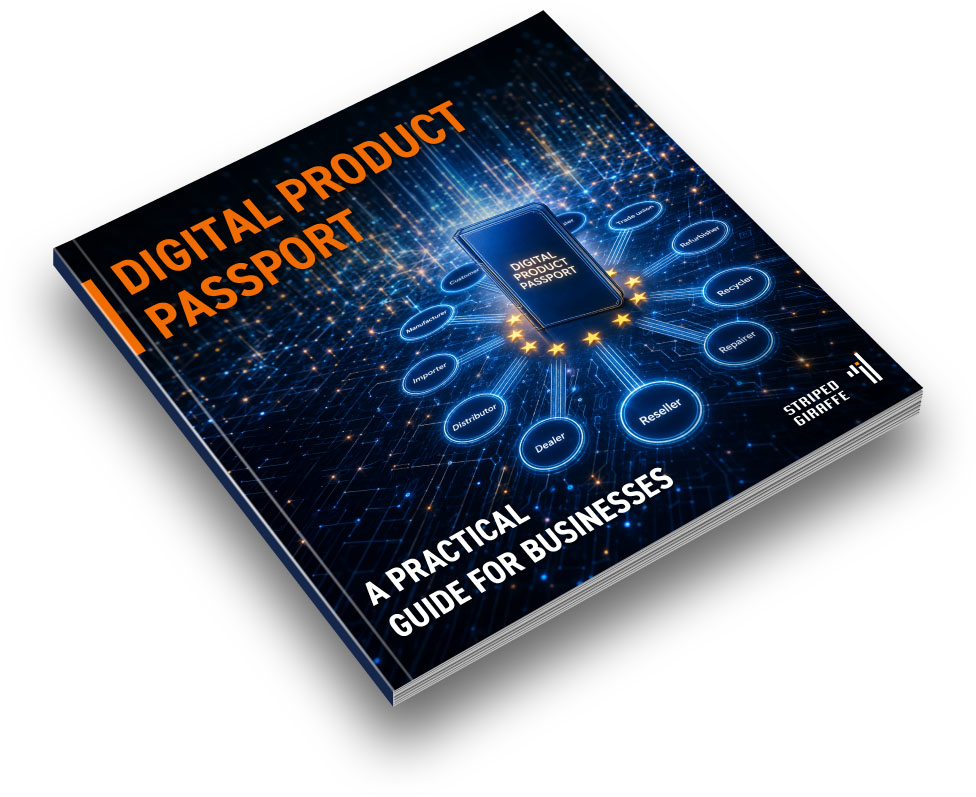
To help you prepare for the Digital Product Passport, we have created a concise booklet with key insights including:
- How DPP works
- What data is included
- Which product categories are affected
- The underlying legal framework
- Key milestones on the implementation timeline
Read more in our blog.
Let’s talk
Do you need a specific offer or a sparring partner to discuss ideas?
Just contact us:
- experts@striped-giraffe.com
- +49 (0)89-416 126-667
We will be happy to support you.
WE CREATE ADDED VALUE FOR OUR CUSTOMERS.
This leads to a long-term cooperation with our customers, which we appreciate very much. You can find even more e-books, case studies, and co. in our Insights.