

by Striped Giraffe Team
15. September 2026
Reading time: 9 Minutes
Equipment as a Service: How Operational Data Becomes Revenue
The monetization architecture behind usage-, output-, availability-, and performance-based business models.
The hardest part of Equipment as a Service (EaaS) is not designing the business model. It is turning operational events into commercial transactions — reliably, transparently, and at scale.
Equipment as a Service continues to attract manufacturers across industrial equipment, construction, healthcare, mobility, and other asset-intensive sectors. Adoption remains selective, however. Moving from a one-time equipment sale to an ongoing service relationship changes far more than pricing.
Customers gain flexibility and can align costs more closely with usage or business outcomes. Manufacturers gain recurring revenue, deeper customer relationships, and greater visibility into how their products create value over time.
But once pricing models and contracts have been defined, a more difficult question emerges: Can the organization measure what happened, apply the right commercial rules, bill it correctly, recognize the revenue, and explain the result to the customer?
What Equipment as a Service Actually Changes
Equipment as a Service is a commercial model in which customers pay for access, usage, availability, output, or performance rather than acquiring equipment through a conventional one-time purchase.
Unlike a conventional sale, EaaS extends the commercial relationship throughout the operational life of the asset. It also differs from simple leasing or rental: the supplier typically assumes greater responsibility for service delivery, equipment performance, or an agreed outcome.
EaaS is one specific form of the broader shift toward servitization. Other service-based business models may generate revenue from maintenance contracts, digital services, managed services, spare parts, consulting, or outcome-based support without turning the equipment itself into an ongoing service.
Different manufacturers apply EaaS in different ways:
- Pay-per-use: machine hours, production cycles, distance traveled, or energy consumed
- Pay-per-output: parts produced, tons processed, packages filled, or labels printed
- Availability-based contracts: payment linked to uptime or operational readiness
- Performance-based contracts: compensation tied to throughput, efficiency, or another agreed result
- Hybrid models: a recurring base fee combined with usage charges, service fees, or performance incentives
Despite their differences, all EaaS models extend the commercial relationship beyond equipment deployment. Revenue therefore depends on the ability to measure and monetize operational activity over time.
EaaS also changes how investment and risk are distributed. Because the provider often retains ownership of the equipment, it may need to finance the asset over a longer period while assuming utilization, performance, maintenance, and residual-value risks.

Trust Comes Before Revenue
One persistent assumption surrounding EaaS is that customers primarily care about financial flexibility. Lower upfront investment, predictable costs, and reduced capital commitments certainly matter. In practice, however, economics alone rarely determine adoption.
A particularly interesting example comes from TRUMPF.
TRUMPF’s Pay per Part initiative illustrates the broader concern. Customers did not only ask what the service would cost. They also questioned accountability, operational control, transparency, and commercial predictability.
Those concerns are rational. When the commercial relationship becomes continuous, customers need to understand how usage is measured, how charges are calculated, how service commitments are monitored, and how disputes will be resolved.
TRUMPF responded by giving customers digital visibility into machine utilization, service information, cost drivers, and operational performance. The broader lesson is clear: transparency is not an optional feature of an EaaS offer. It is a prerequisite for trust.
Without transparency, every invoice invites questions. With it, both parties can rely on a shared operational reality.
From Operational Event to Commercial Event
At the center of every EaaS model lies a deceptively simple question: What exactly happened?
The answer may be a machine hour, a completed production cycle, a period of availability, a delivered service level, or a verified business outcome.
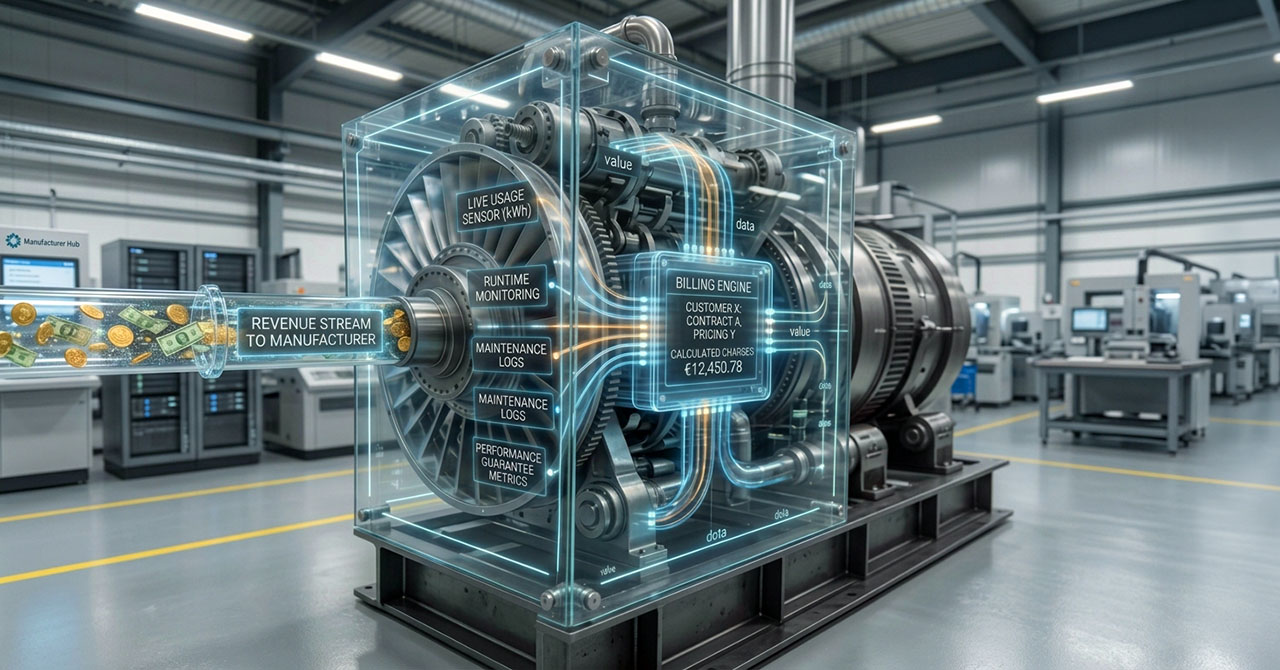
A raw operational signal does not become billable simply because it exists. It must pass through a chain of business and technical controls:
| Stage | Purpose |
| 1. Capture | Machines, sensors, edge systems, and service applications record usage, output, condition, or performance. |
| 2. Validate and enrich | The event is checked and enriched with asset, customer, location, and service information. |
| 3. Match to the contract | The applicable contract, entitlement, pricing plan, threshold, or service level is identified. |
| 4. Create a commercial event | The validated operational event is translated into a billable quantity or a contractual outcome. |
| 5. Rate and bill | Pricing rules calculate the charge, including tiers, commitments, discounts, credits, and exceptions. |
| 6. Settle and recognize | The charge flows into invoicing, payment collection, accounting, and revenue recognition. |
| 7. Explain | Customers and internal teams can trace the invoice back to the underlying events, rules, and service performance. |
This translation is the critical step. Operational data may support maintenance and optimization, but in EaaS it also becomes evidence of value delivered — and therefore part of the revenue process.

The Architecture Behind EaaS Monetization
No single platform runs the entire EaaS model. What connects the architecture is a shared understanding of assets, customers, contracts, entitlements, operational events, commercial rules, and financial outcomes.
A scalable architecture usually spans the following layers:
- Equipment and IoT layer: machines, sensors, edge systems, and asset telemetry
- Data and integration layer: APIs, event streaming, validation, master data, orchestration, and event storage
- Commercial layer: CRM, CPQ, contract management, subscriptions, pricing plans, and entitlements
- Monetization layer: metering, aggregation, rating, usage-based billing, and invoicing
- Financial layer: asset financing, payments, collections, ERP, accounting, tax, revenue recognition, and risk management
- Experience layer: customer portals, self-service, usage views, service reports, and invoice explanations
- Governance layer: data quality, lineage, security, audit trails, compliance, and operational monitoring
The architecture is held together by integration, but connectivity alone is not enough. Every system must interpret core business objects consistently. A machine identifier must refer to the same asset across telemetry, service, contracts, billing, and finance. A pricing rule must be linked to the correct contract version. A corrected event must remain traceable to the invoice and accounting entry it changed.
This is why data governance and master data management are commercial capabilities in an EaaS model, not merely technical disciplines. When operational and commercial records diverge, invoices become difficult to defend, disputes increase, and scaling becomes considerably harder.
What Market Examples Reveal
TRUMPF: Pay per Part
From an architectural perspective, TRUMPF’s model requires production results to be validated, assigned to the correct customer and contract, and translated into billable output. The same information must then support both invoicing and the customer-facing performance view.
Kaeser: Compressed Air as a Utility
With SIGMA AIR UTILITY, customers pay a fixed basic price for an agreed quantity of compressed air and a defined contractual price for additional consumption. Kaeser retains responsibility for the compressed-air system and its operation. The model shows how metering, availability, service delivery, and tiered commercial rules come together.
Rolls-Royce: Usage-Based Service and Risk Transfer
Rolls-Royce TotalCare combines long-term engine services with a dollar-per-flying-hour payment mechanism. Its defining feature is not simply usage-based charging. Operational and maintenance risk is transferred back to the provider, making monitoring, lifecycle management, and predictive service capabilities integral to the commercial model.
The implementations differ, but all three demonstrate the same principle: the commercial offer can only work when operational evidence, contractual logic, and financial execution remain connected.
Why Billing and Payments Become Part of the Product
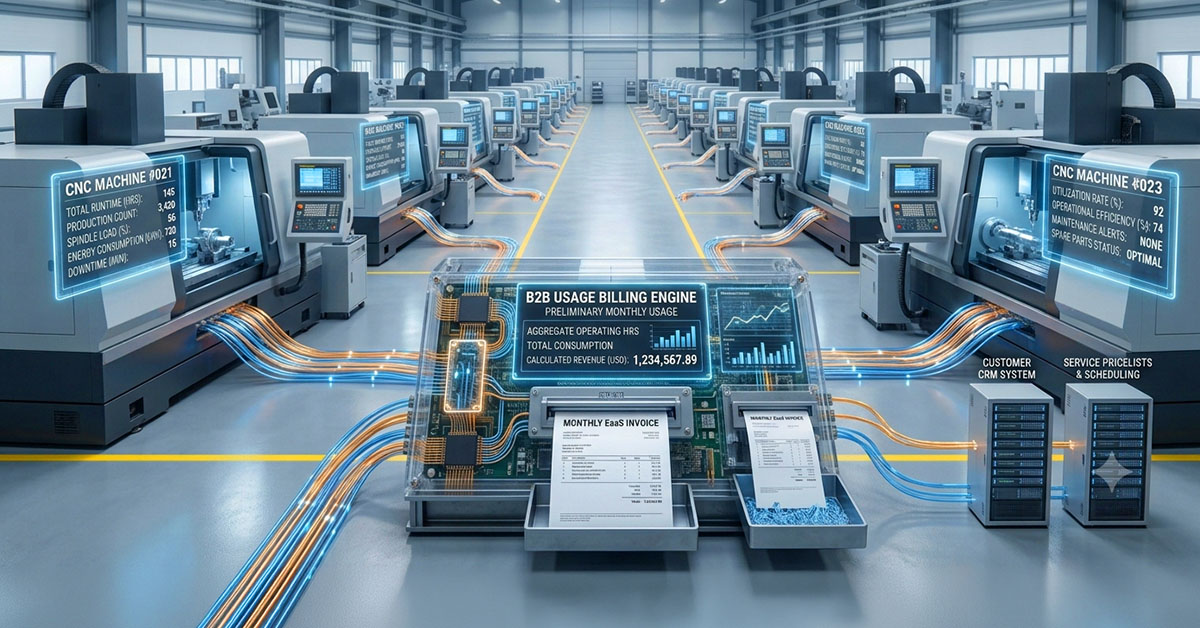
Traditional equipment businesses often process a relatively small number of high-value transactions. EaaS introduces recurring interactions throughout the customer relationship – fixed charges, variable usage, credits, adjustments, renewals, upgrades, and exceptions.
That creates requirements that many ERP-centric environments were not designed to handle on their own:
- usage aggregation and rating
- recurring and hybrid billing
- automated invoicing and payment collection
- failed-payment handling and collections
- contract changes and mid-cycle adjustments
- reconciliation and revenue recognition
Billing and payment infrastructure therefore influence the customer experience as much as the financial architecture. A sophisticated pricing model loses much of its value if customers cannot understand a charge, reconcile it with their own records, or pay through an appropriate method.
Platforms such as Stripe can provide key components of this monetization layer, including usage aggregation, flexible pricing, recurring and usage-based billing, invoicing, payment collection, and revenue recognition. The implementation challenge lies in validating operational events and connecting these capabilities with the manufacturer’s asset, contract, operational, and financial systems.
What Manufacturers Need to Scale EaaS
The strategic question is not whether one platform can support Equipment as a Service end to end. In most organizations, it cannot. The relevant question is whether the operating model can keep the following elements aligned throughout the service lifecycle:
- the equipment and the customer using it
- the contract and the service entitlement
- the operational event and the commercial rule
- the charge, invoice, payment, and accounting treatment
- the provider’s record and the customer’s view of what happened
Manufacturers do not need to replace every system before launching EaaS. They do need a clear target architecture, reliable ownership of core data, executable commercial rules, and an integration layer capable of handling events and exceptions at scale.
The business model is often the easy part. The real challenge begins when the model has to work every day, at scale, for every customer, across every contract.
Building the monetization architecture for Equipment as a Service requires more than selecting a billing platform. We support manufacturers in connecting operational data, commercial rules, Stripe-based billing capabilities, and existing enterprise systems within a scalable operating model.
You might also like:
- Industrial Aftermarket: From Spare Parts Business to a Scalable Revenue Engine » Learn more
- E-Book: Digital Self-service & automation in B2B e-commerce » Learn more
- Search in B2B e-commerce can be a strategic differentiator » Learn moren
- E-Book: Build, Buy, or Orchestrate? Rethinking Commerce » Learn more
- The Tech Backbone of Subscription-Based E-Commerce » Learn more
- E-Book: Modern B2B Commerce — Beyond Transactions » Learn more